


















Key Insights
- To build lasting operational resilience, modern enterprises must break down departmental silos and integrate risk, digital transformation, and sustainability into one unified strategy.
- Risk management must evolve from a defensive compliance exercise into a proactive, strategic capability that safely guides rapid technological innovation.
- Moving beyond regulatory checkboxes, organisations must embed sustainable and ethical practices directly into their core operations to drive measurable, long-term business value.
For years, companies managed critical business functions in strict isolation. Often, they treated enterprise risk management as a defensive control, viewed technology as a basic enabler, and relegated sustainability to a standalone corporate initiative.
However, as the business landscape grows more volatile, this fragmented approach creates dangerous blind spots. Leaders now realise they cannot safely pursue a digital transformation strategy without assessing its threats, nor navigate modern challenges without embedding both risk and technology into a sustainable framework.
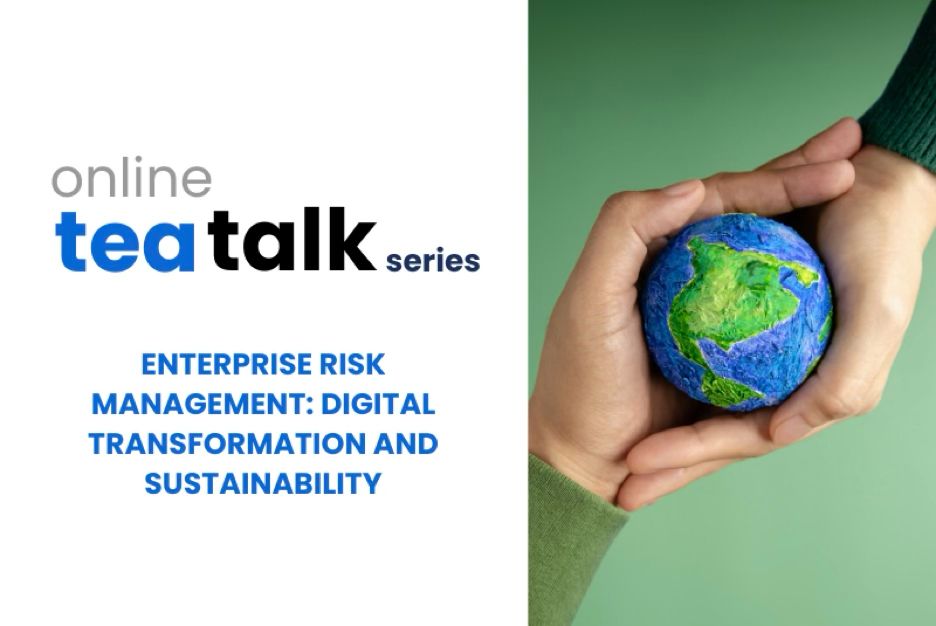
Securing operational resilience requires businesses to embrace an irreversible shift. To unpack what this means in practice, the Institute of Enterprise Risk Practitioners (IERP®) hosted a Tea Talk titled “The Future of Enterprise Strategy: Navigating the Triple Convergence of Risk, Digital Transformation & Sustainability”.
Featuring Ramesh Pillai, Chairman of the Board of Governors of the IERP®, and Mahidon Promwichit, Vice President of Sustainability at a Banking Group, the session examined how firms must adapt to a landscape where these three disciplines are no longer separate functions, but interdependent pillars of long-term success.
Moving Enterprise Risk Management from Defensive Controls to Risk Optimisation
Today, enterprise risk management is rapidly evolving from a defensive mechanism into a strategic capability. Modern enterprises must look beyond traditional risk avoidance and focus instead on risk optimisation. This proactive approach empowers leaders to take calculated risks that generate substantial business value while maintaining operational resilience.
To achieve this level of risk optimisation in practice, teams must establish and apply a clear risk appetite. When leadership teams clearly define the level of risk they are willing to accept in pursuit of their strategic objectives, they shift the corporate mindset away from simply preventing all potential losses.
This clarity provides the essential foundation required to evaluate whether the potential strategic rewards of a new business initiative justify the inherent exposure. Rather than functioning as a rigid barrier to progress, this evolved framework ensures that every business decision balances agility with necessary protection against a full spectrum of risks, including Environmental, Social, and Governance (ESG) risks.
Executing these calculated, value-driven risks requires a new breed of professionals. As Ramesh explained, “The risk manager of the future needs to understand technology and sustainability just as well as they understand finance.”
This interdisciplinary approach transforms enterprise risk management from a compliance exercise into a direct catalyst for sustainable growth.
Navigating the Dual Nature of Digital Transformation
A comprehensive digital transformation strategy introduces massive business opportunities, but it simultaneously exposes organisations to unprecedented vulnerabilities. As companies move from planning to executing their digital transformation, they rapidly expand their traditional risk profile. Teams must now actively manage complex technological threats, including cybersecurity breaches, compromised data integrity, and algorithmic bias.
Furthermore, if leaders fail to properly manage these new technologies, the very systems meant to drive progress will instead generate severe privacy issues and complex ethical dilemmas, particularly concerning artificial intelligence.
Managing this tension between innovation and vulnerability is primarily a challenge of pacing. Leaders must ensure their corporate governance frameworks and culture evolve at the same speed of technological advancement. When innovation outpaces internal controls, it creates dangerous blind spots.
Echoing Ramesh’s warnings on risk, Mahidon emphasised that safely navigating this dual nature of digitalisation requires leaders to firmly commit to responsible innovation. Organisations must proactively design systems where technological tools serve both economic targets and broader social objectives.
By aligning rapid technological deployment with robust governance, companies ensure they harness these advancements without ever compromising their underlying integrity.
Embedding Sustainability Beyond Compliance
Addressing this shift, Mahidon noted that many businesses still perceive sustainability as a compliance-driven obligation. “Sustainability is not just about being green,” he explained. “It’s about ensuring business longevity through ethical, responsible, and transparent practices that align with stakeholder expectations.”
To achieve this, companies must measure their environmental and social commitments with the exact same rigour they apply to financial performance. Digital tools deliver the data-driven insights required for robust ESG reporting and proactive ESG risk management. Through these technologies, companies can accurately track carbon footprints, achieve total supply chain transparency, and optimise resource efficiency.
Global frameworks like the UN Sustainable Development Goals (SDGs) and evolving ESG standards also offer essential guiding structures to integrate technology and risk seamlessly. Financial institutions demonstrate this integration powerfully.
By championing responsible lending and sustainable financing, they embed strict sustainability criteria directly into their investment decisions. This approach allows them to influence how capital flows, driving tangible global change while simultaneously managing long-term business and ESG risks. At its core, these practices transform sustainability from a regulatory checkbox into a measurable engine for enduring corporate resilience.
Breaking Silos Through Strong Corporate Governance
Managing the triple convergence of risk, technology, and sustainability requires enterprises to break down entrenched departmental silos. Enterprise risk management, technological innovation, and sustainability can no longer function as isolated units; they must converge strategically under shared objectives.
While many organisations possess separate digital or sustainability roadmaps, few execute true enterprise strategies that unify all three dimensions. Highlighting the risks of this gap, Ramesh cautioned, “Transformation without governance is chaos. And governance without transformation is stagnation. The future belongs to organisations that can balance both.”
Achieving this balance is impossible without robust corporate governance and proactive board oversight. The greatest barrier to convergence is rarely a lack of frameworks, but rather an absence of clear ownership. Boards must explicitly define enterprise-level accountability, ensuring executive teams align their strategy and performance metrics with the organisation’s overall risk appetite.
Furthermore, this unified approach directly supports effective stakeholder engagement. Customers, investors, and regulators no longer accept the mere existence of internal policies; they demand transparency, accountability, and measurable outcomes. By establishing clear ownership and integrating these core pillars, businesses transform their internal sustainability and risk conversations into tangible, external commitments that drive long-term value.
Key Lessons for Risk Leaders
The modern business landscape requires a decisive shift. Firms must stop treating risk, technology, and sustainability as separate departments and integrate them as interdependent pillars. To achieve this, risk teams and leaders should focus on four key takeaways from the session.
Reimagining Enterprise Risk
Leaders must transform enterprise risk management from a defensive compliance mechanism into a strategic capability, optimising calculated risks to drive sustainable value.
Governing the Digital Shift
As companies execute their digital transformation, they must balance rapid technological adoption with updated control frameworks to secure responsible innovation.
Making Sustainability Strategic
Organisations need to move beyond compliance-driven ESG reporting. True environmental and social stewardship embeds ethical, transparent practices directly into corporate strategy to guarantee business longevity.
Driving Cultural Transformation
Successful integration demands proactive leadership, clear ownership, and teams equipped with strong digital literacy and ESG awareness.
Ultimately, this convergence offers a distinct opportunity for market differentiation where resilience meets innovation. As the Banking Group’s Vice President of Sustainability shared: “Technology gives us speed, risk management gives us control, and sustainability gives us direction. When all three are aligned, the organisation becomes both agile and accountable.”