


















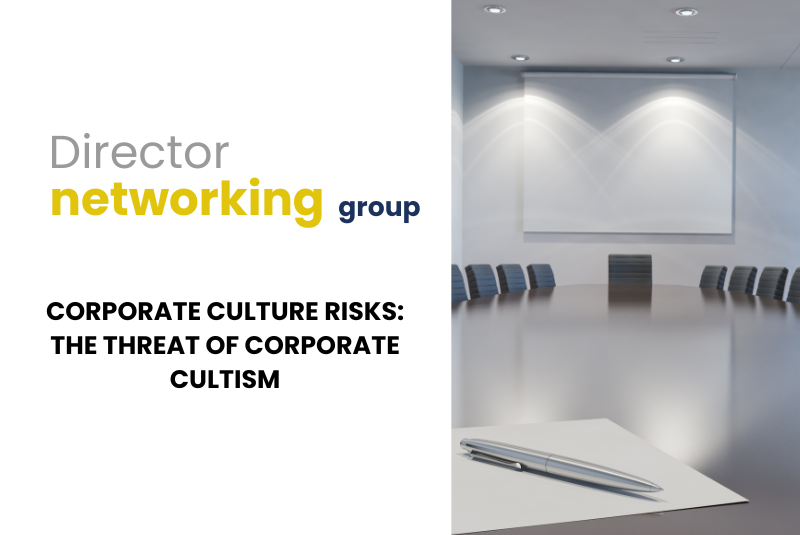
The Directors Networking Group session under the theme, “Corporate Cultism: The Silent Threat in the Boardroom” explored how a cult-like corporate culture jeopardises enterprise risk management
Key Insights
- Corporate cultism takes root when blind loyalty to a dominant leader replaces constructive debate, quietly transforming a healthy culture into a dangerous echo chamber.
- This unchecked groupthink severely compromises enterprise risk management by systematically filtering out bad news and rationalising risks to maintain an illusion of unity.
- To protect the organisation, boards must actively cultivate psychological safety and champion cognitive diversity so that constructive challenge is always valued over quiet compliance.
A healthy corporate culture is rooted in a shared loyalty to principles. However, a silent threat emerges when this transforms into uncritical loyalty to a single personality or dominant ideology. That is corporate cultism.
When blind devotion quietly replaces constructive debate, independent thinking vanishes. Boards start to rationalise risks, filter out bad news, and compromise the organisation’s long-term goals to maintain an illusion of unity.
Recognising how easily this dynamic can take root, the Institute of Enterprise Risk Practitioners (IERP®) convened its Directors Networking Group (DiNG) session under the theme, “Corporate Cultism: The Silent Threat in the Boardroom”.
Led by Ramesh Pillai, Chairman of the Board of Governors of the IERP®, board members and senior leaders explored the emergence of this phenomenon and its often-overlooked impact on boardroom effectiveness, integrity, and accountability.
Spotting the Early Warning Signs of Groupthink
Corporate cultism rarely announces itself through overt misconduct. Instead, it creeps in subtly, often disguised as unity or alignment.
The result is a gradual descent into groupthink where decisions go unchallenged, risks are rationalised, and accountability becomes selective. When that happens, it blinds key decision-makers to critical threats and severely jeopardises enterprise risk management.
For directors looking to assess their own vulnerability, the early warning signs usually manifest in a few distinct ways.
The erosion of constructive challenge
Dissenting voices are gradually suppressed, and board members may hesitate to question management decisions out of fear of isolation or reprisal. A healthy boardroom should encourage intelligent dissent. If everyone is agreeing all the time, something is wrong.
Narrative control
Upward reporting becomes heavily filtered, curated, or overly optimistic. This creates a dangerous illusion of stability and success, intentionally leaving out bad news that might disrupt the prevailing consensus.
Conflating loyalty with agreement
Decisions go unchallenged and risks are rationalised because leadership begins to equate loyalty with unquestioning support.
When these symptoms take root, oversight is compromised, leading to risk denial, distorted reporting, and the loss of objectivity in strategic decision-making.
How Unchallenged Loyalty Breaks Enterprise Risk Management
Effective enterprise risk management relies on an objective reality. In a cult-like corporate culture, risk reporting is often manipulated to fit the leadership’s preferred narrative. Threats that contradict this consensus are systematically minimised or ignored entirely, leaving leadership with a false sense of control.
To catch this deterioration before it compromises the organisation, boards need a practical way to assess if their governance is failing. Ramesh introduced the “ABC” of corporate integrity as a diagnostic tool to evaluate this drift:
- Attitude: The true values and the tone set from the top.
- Behaviour: How those values translate into daily operations and decision-making.
- Culture: The collective expression of both attitude and behaviour.
A cult-like corporate culture takes root the moment these three elements fall out of alignment. As Ramesh warned, “If your attitude is defensive, your behaviour will be resistant, and your culture will eventually become toxic.”
Evaluating this framework allows boards to spot early warning signs of moral complacency. It acts as a vital stress test, ensuring that enterprise risk management remains robust and that the corporate culture rewards honest reporting rather than unquestionable compliance.
Strategies to Build Psychological Safety in the Boardroom
For a board to function effectively, dismantling corporate cultism requires deliberate action. It is about ensuring that constructive challenge is valued over quiet compliance. Ramesh outlined several practical steps to break echo chambers, protect independent oversight, and weave psychological safety into the heart of corporate culture.
Champion cognitive diversity
True diversity extends far beyond demographics; it involves bringing in individuals who think differently and are unafraid to challenge convention.
Regular board development programmes, scenario planning exercises, and facilitated discussions cultivate the psychological safety necessary for cognitive diversity to flourish, providing a natural antidote to groupthink.
Prevent entrenchment of unhealthy power dynamics
Long tenure and deep familiarity can blur the lines between governance and management, slowly fostering a cult-like corporate culture where tough questions are no longer asked.
To maintain independence of mind and clarity of purpose, boards should implement regular evaluations, structured succession planning, and rotational policies, ensuring directors do not lose their critical edge.
Measure ethics in performance evaluations
Boards must demonstrate through action that integrity matters more than short-term gains.
Executive appraisals should explicitly include ethical and governance indicators, rather than relying solely on financial results.
Anchor whistleblowing frameworks in genuine trust
Transparency mechanisms cannot function as safeguards against cult-like tendencies if employees fear reprisal.
They only work when psychological safety underpins the process, enabling individuals to speak up before a problem escalates into a crisis. After all, whistleblowing frameworks do not protect organisations; a resilient corporate culture does.
Utilise external perspectives to expose blind spots
It is easy for boards to become insular. Bringing in independent assurance, third-party reviews, or external benchmarking serves as a necessary mirror.
The difference between good and bad governance is whether these blind spots are recognised or ignored.
Key Lessons For Boards of Directors
Implementing strategies to dismantle echo chambers is not a one-off exercise; it requires a permanent shift in how leadership operates. The greatest vulnerability for any board is complacency, particularly when an organisation is performing well.
When revenues are up and operations appear smooth, it becomes dangerously easy to relax oversight and let strong personalities dictate the narrative. To ensure safeguards hold up under pressure, directors must anchor their approach in a few defining principles:
- Look beyond the balance sheet: Success can be the ultimate mask for decay. Exceptional financial results are often used to justify toxic compliance and excuse the early stages of groupthink. Decision-makers must evaluate how results are achieved, not just the numbers themselves.
- Remain vigilant for early warning signs: Corporate cultism does not happen overnight. Directors must actively monitor for the subtle symptoms, such as heavily filtered narrative control or the suppression of constructive dissent, and address them before they become the norm.
- Treat governance as a mindset, not a checklist: While frameworks and reporting lines are necessary, true governance cannot be automated. It relies entirely on the courage of directors to remain fiercely independent and ethically grounded.
- Value humility over ego: Leaders must be willing to invite and accept meaningful challenge. A healthy corporate culture that prioritises truth-telling over the protection of leadership egos is naturally resistant to cult-like tendencies.
- Weaponise transparency against silence: Cultism thrives in the shadows. Organisations must actively cultivate psychological safety, ensuring the boardroom remains an environment where asking difficult questions is expected, and speaking up is rewarded rather than indirectly penalised.
Ultimately, the descent into corporate cultism is rarely a sudden collapse; it is a gradual erosion. What begins as an unhealthy corporate culture, like an over-reliance on a dominant leader or a silent discouragement of dissent, can quietly evolve into uncritical devotion.
When this happens, it systematically strips away oversight effectiveness, compromises sound governance, and leaves the organisation vulnerable to critical threats, fundamentally breaking enterprise risk management. The best protection against this silent threat is a board that refuses to stop asking the hard questions.