

















Enterprises today can no longer downplay quantum technologies as a distant concept; it is now a pressing corporate concern.
Key Insights
- Quantum computing is an emerging enterprise reality that will render traditional business infrastructure vulnerable.
- Adversaries actively hoard encrypted data in a “harvest now, decrypt later” strategy, waiting for quantum hardware to mature.
- Risk practitioners must secure quantum-ready infrastructure today to turn this existential threat into a strategic advantage.
Business failures rarely stem from visible dangers; they emerge from unfamiliar disruptions we choose to ignore. When evaluating technology risk, organisations often weigh the likelihood and impact of familiar dangers while missing catastrophic, low-frequency events.
Today, one of the most severe threats on the corporate horizon is quantum risk. Often written off as science fiction, quantum advancement is quickly becoming an impending reality. Ignoring this transition threatens business survival, but proactively quantifying it unlocks a clear strategic advantage.
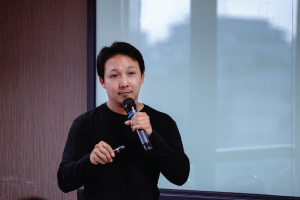
At the Institute of Enterprise Risk Practitioners’ (IERP®) Global Conference 2026, Professor Manas Mukherjee decoded this disruption. As an Associate Professor and Principal Investigator at the National University of Singapore’s Centre for Quantum Technologies, he unpacked why mastering quantum technology is no longer optional for the enterprise.
History Repeats: The Cost of Ignoring Technology Risk
Underestimating quantum advancements today mirrors the fatal mistakes made by corporate giants of the past. As Dr Mukherjee highlighted, history brutally punishes organisations that fail to anticipate the next era of innovation led disruptions.
Consider Blockbuster in 2000. While generating billions in revenue, the company completely ignored the fundamental shift toward the internet. It famously rejected a $50 million opportunity to acquire Netflix, choosing instead to double down on physical stores and late fees.
Similarly, Nokia dismissed the impending ecosystem of touchscreens and apps to protect its existing mobile market share. Both giants fell from dominance to bankruptcy because they treated disruptive innovation as a passing trend rather than an existential threat.
Modern enterprises now face the exact same blind spot. The cost of mismanaging technology risk has never been higher, especially in 2026. While artificial intelligence (AI) currently evolves in mere weeks, quantum computing is rapidly moving out of the laboratory and scaling into cloud-based enterprise systems.
Highlighting this unprecedented pace, Dr Mukherjee used the current AI boom to illustrate how quickly technological tipping points arrive: “We are witnessing a real acceleration… we just don’t know how big the AI is going to be next week.”
Just as the internet redefined global commerce two decades ago, quantum architecture will mercilessly separate the prepared from the obsolete.
The Limits of Silicon and the Power of Quantum Technologies
As the information era hits its hardware limits, an evolution towards quantum architecture is inevitable. For decades, Moore’s Law, the rule that computing power doubles roughly every 1.5 years, fuelled our digital economy.
However, as we push further into 2026, classical silicon architecture is hitting a plateau. Businesses are reaching the fundamental physical limits of how small we can make these chips. Furthermore, the massive energy costs needed to run classical supercomputers for advanced data processing and generative AI have become unsustainable.
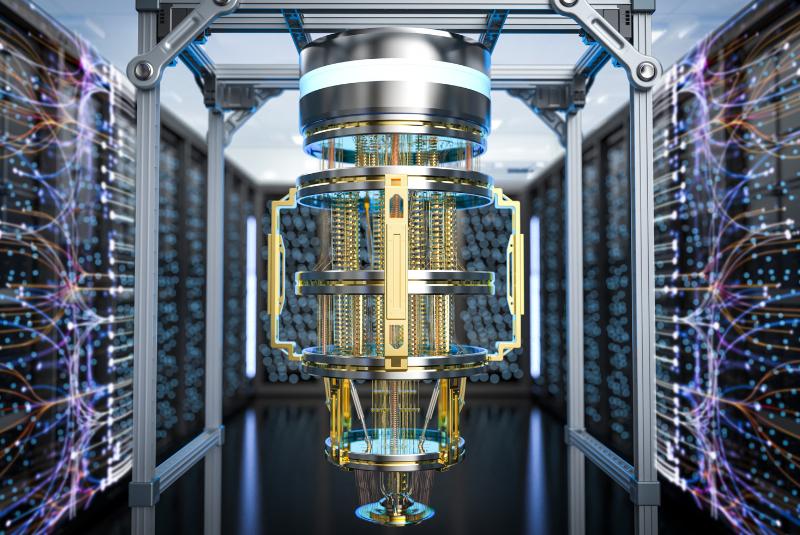
To break past this physical barrier, enterprises must look to quantum technologies. While classical systems process information sequentially as either a 1 or a 0, quantum systems harness superposition: they exist in multiple states at once.
This grants us true parallel processing. Dr Mukherjee illustrated this exponential power with a visual analogy: if you fold a standard piece of paper just 50 times, its thickness multiplies (exponential scaling) so aggressively that it reaches the moon.
This parallelism amplifies further through entanglement, a principle where quantum particles instantly share states regardless of distance. Consequently, the system can execute complex operations in a single step rather than millions. It is not just a faster computer; it is a fundamentally new way of solving the unsolvable.
The Immediate Quantum Risk: “Harvest Now, Decrypt Later”
While quantum’s parallel processing offers incredible power, it also introduces a critical vulnerability for current data encryption. Assessing this quantum risk means looking past future hypotheticals to confront the silent data theft happening right now.
The most severe threat in 2026 is the ‘harvest now, decrypt later’ strategy, where attackers actively intercept and hoard encrypted enterprise data. They cannot read it yet, but they are waiting.
As Dr Mukherjee warned, “If you have a powerful enough quantum computer, you can break any crypto system that currently exists based on mathematically sound RSA system.” Once quantum algorithms shatter current RSA mathematical constructs, they will expose years of intellectual property and financial records.
It may sound like science fiction, but adversaries already use undersea cable taps and Border Gateway Protocol hijacking to capture data at scale. They actively reroute bulk internet traffic, such as government data and financial communications, through adversarial infrastructure, archiving encrypted packets until quantum computers can crack them.
When mapped onto a Financial Institutions Risk Matrix, Dr Mukherjee placed these attacks firmly in the red zone for both likelihood and impact. “Whatever is available, you take home and wait for the quantum computers to be big enough to break the RSA code,” he explained.
If organisations wait until the technology matures to upgrade their defenses, that intercepted data is already compromised.
Unlocking Strategic Advantage in Enterprise Risk Management
While defending against data theft provides a baseline, modern enterprise risk management requires expanding the organisation’s risk appetite to capture new technological opportunities.
By acting early, risk practitioners can guide their organisations to securely adopt quantum infrastructure ahead of competitors, ensuring the impact of this transformation is a strategic advantage rather than a fatal disruption.
Beyond security, quantum systems accelerate complex initiatives like drug discovery and advanced machine learning. Dr Mukherjee highlighted his own lab’s success using quantum machine learning to classify cancerous cells, proving these quantum models deliver superior accuracy and confidence limits even when trained on minimal data sets.
Fortunately, harnessing this power does not require building a supercomputer from scratch. Enterprises can bypass massive capital expenditure by accessing these capabilities via the cloud. Yet, selecting a provider forces businesses to navigate an ongoing hardware race, choosing primarily between superconducting circuits and ion trap architectures.
Crucially, this reliance introduces significant third-party risk. Risk managers must begin auditing their cloud vendors today, assessing not just their current security posture, but their cryptographic agility and quantum-readiness.
Furthermore, strict geopolitical export controls govern this cloud access. Because these machines offer a definitive national and commercial advantage, the US and European governments heavily regulate their distribution. For risk professionals, securing reliable access to quantum infrastructure today constitutes a vital pillar of long-term business continuity.
Mastering Quantum Risk for Future Enterprise Resilience
Navigating these infrastructure hurdles and securing the enterprise against quantum disruption demands proactive education and swift action. Tactics like ‘harvest now, decrypt later’ score alarmingly high on the risk matrix today. This reality transforms quantum risk from a theoretical IT concern into a mandatory pillar of enterprise resilience.
Leaders can no longer afford to delay their strategic response. The choice facing boardrooms today is clear: remain blind to the technological tide or actively turn this awareness into a definitive competitive edge.
As Dr Mukherjee challenged the audience during his closing remarks, every enterprise faces a stark ultimatum: “Ignorance is bliss, knowledge is power. You decide which one you want to take.”