


















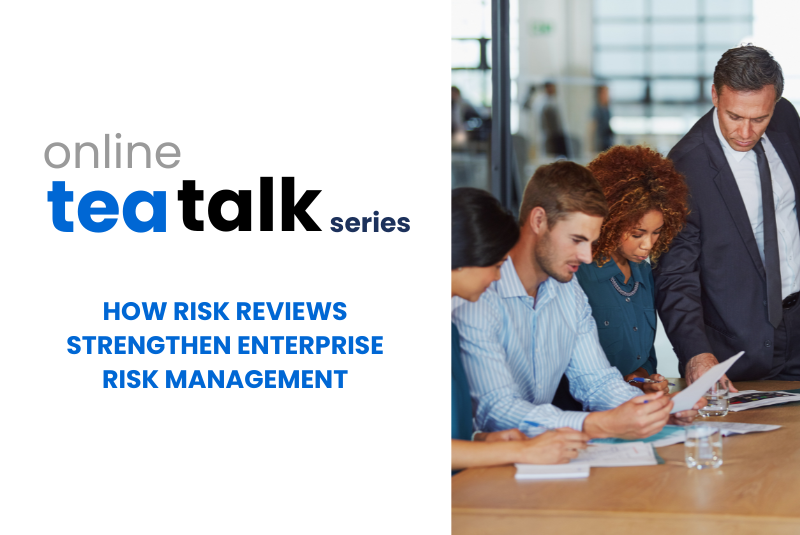
The Tea Talk, titled “Navigating Uncertainties: A Comprehensive Guide to Risk Reviews”, explored how risk reviews strengthen governance, support decision-making, and enhance organisational resilience.
Key Insights
- Risk reviews must evolve from static compliance exercises into dynamic tools integrated directly with an organisation’s strategic planning.
- Continuously evaluating existing controls against emerging threats empowers management to make informed trade-offs between risk and value creation.
- Building true resilience requires breaking down departmental silos to foster transparent, cross-functional ownership of risk management.
In today’s volatile business environment, uncertainty has become the norm rather than the exception. Enterprises operate in a complex landscape where risks shift rapidly and unpredictably. Since corporate leaders cannot eliminate every threat, an effective enterprise risk management framework is critical, but building a robust one remains a significant daily challenge.
Unchecked volatility severely weakens decision-making and leaves businesses exposed. Relying on outdated assumptions creates critical blind spots across an organisation, while static compliance exercises and rigid controls quickly lose their effectiveness. Consequently, leadership struggles to identify, prioritise, and mitigate emerging threats.
The solution lies in disciplined and continuous assessments. Addressing this operational gap, the Institute of Enterprise Risk Practitioners (IERP®) explored how structured risk reviews solve this challenge. Led by Ramesh Pillai, Chairman of the Board of Governors of the IERP®, this session outlined a practical framework for systematically evaluating existing controls and validating the core assumptions that protect the business.
Aligning Risk Assessments with an Organisation’s Risk Appetite
A well-structured review process is central to robust enterprise risk management. It ensures management decisions stay aligned with the company’s strategic goals and its defined risk appetite. Rather than treating reviews as a mere compliance exercise, leadership must view them as an essential management tool.
At its core, a comprehensive risk assessment serves a dual purpose: it evaluates the effectiveness of existing frameworks and validates the core assumptions that underpin them. By routinely testing these guardrails, leadership teams uncover blind spots, drive proactive risk mitigation, and reveal clear areas for continuous improvement.
Beyond the mechanics, these reviews drive candid conversations across departments. This open dialogue breaks down silos, fosters collective ownership, and strengthens overall risk governance. Practitioners should approach risk reviews with curiosity rather than defensiveness.
All in all, transforming these insights into a strategic advantage requires the right review frequency. This cadence enables leadership to consistently evaluate every existing risk control and remain agile enough to identify emerging risks on the horizon.
Optimising Review Frequency to Evaluate Controls and Catch Emerging Risks
The ability to evaluate existing controls and spot emerging risks depends heavily on how often corporations conduct their reviews. While there is no universal schedule, review frequency must align with a company’s specific environment and risk profile, industry dynamics, and exposure to change.
Fast-paced sectors like finance or aviation may require at least quarterly reviews, whereas more stable industries may safely opt for semi annual or annual assessments.
However, frequency alone does not guarantee resilience. Success depends not on how often reviews occur, but on how effectively teams execute them. To ensure these exercises deliver value rather than becoming an administrative burden, a comprehensive risk assessment should include three essential components:
- Assessment of existing risk control: Are current safeguards still relevant and effective against known threats?
- Evaluation of emerging risk: What has shifted in the external environment and what new challenges have surfaced?
- Alignment with strategic objectives: Do the current strategies accurately reflect the enterprise’s evolving goals and defined risk appetite?
By systematically answering these questions and actively tracking key risk indicators, businesses move beyond static compliance. They transform their reviews into agile, living tools that drive sustained improvement and protect long-term objectives.
Transforming the Risk Register from a Static Log to a Strategic Asset
Risk reviews must integrate directly with strategic planning. Too often, enterprise risk management operates in isolation, disconnected from business strategy. If risk reviews do not influence decision-making, they are merely paperwork.
As such, every review must evaluate whether the risks taken represent an informed trade-off for achieving strategic objectives. Open dialogue between risk managers, business leaders, and board members ensures findings are interpreted with the right context.
A common mistake when conducting these reviews is treating the process as a “box-ticking exercise”, where teams update a risk register without critically evaluating whether it reflects current realities.
Another pitfall is an overreliance on subjective judgement. While professional judgement is important, it should be backed by metrics, trend analysis, and external benchmarking. Equally dangerous is identifying risks without enforcing action or accountability. After all, an unimplemented control is as good as a non-existent one.
To overcome this entrenched thinking and enable strategic growth, Ramesh recommended several best practices.
- Establish clear ownership: Every risk should have a designated owner. This individual assumes accountability not just for identifying risk, but for driving active risk mitigation and reporting.
- Conduct evidence-based reviews: While professional judgement remains important, organisations must look beyond it. Complementing qualitative insights with quantitative data, like key risk indicators, trend analysis, and external benchmarking, sets an objective baseline for informed trade-offs.
- Embed feedback loops: Treat reviews as routine health check-ups. Lessons from one cycle must inform improvements in the next to drive ongoing accountability.
- Adopt technology: While automated dashboards and systems streamline the review process, technology serves only as an enabler for irreplaceable human judgement.
Of course, answering these strategic questions requires diverse perspectives. Leadership should break down silos and encourage open dialogue across every department so these insights remain actionable.
Strengthening Risk Governance Through Cross-Functional Collaboration
Risk reviews deliver the greatest value when they actively promote open communication and collaboration across departments. After all, robust risk governance is not achieved by the risk department alone; businesses must treat it as everyone’s business.
To build a truly resilient enterprise risk management framework, leadership must intentionally break down silos across finance, operations, compliance, IT, and strategy. Breaking these barriers requires creating safe spaces for candid discussions, where staff at all levels can raise potential issues without fear of blame. By encouraging this level of transparency, leaders directly strengthen workplace culture and improve overall risk control effectiveness.
This transparent communication transforms risk reviews into proactive opportunities for learning, rather than rigid audits for punishment. Cultivating this environment means inviting multiple perspectives into the evaluation process. When finance, operations, compliance, IT, and strategy teams share their insights openly, companies construct far more holistic and accurate risk assessments.
Driving this cross-functional alignment forms the bedrock of strong risk governance. This shared perspective ensures that risk reviews remain balanced, realistic, and actionable, translating high-level governance directly into everyday decision-making. As every department takes ownership of these operational challenges, routine evaluations shift into a unified culture of accountability.
Key Lessons For Risk Leaders on Enterprise Risk Management
Building a resilient enterprise risk management framework requires enterprises to move beyond rigid compliance. By integrating continuous risk assessments directly with strategic planning and a defined risk appetite, leadership transforms routine evaluations into proactive tools for sustained growth.
Align Controls with Strategic Objectives
Risk reviews must never operate in isolation. By tying risk mitigation efforts directly to business goals, leaders empower themselves to make informed trade-offs that seamlessly balance value creation with effective risk control.
Strengthen Risk Governance Through Collaboration
True resilience relies on cross-functional teamwork. When leaders break down departmental silos and foster transparent, evidence-based conversations, they empower every team to take active ownership of identifying and managing emerging risk.
Treat Reviews as Continuous Learning
Rather than maintaining the risk register as a static log, practitioners must embed feedback loops and track key risk indicators into their everyday operations. By systematically updating methodologies, teams ensure the enterprise learns faster than its risks evolve.
Institutionalise Agility and Preparedness
To navigate external volatility, reviews must evolve alongside the maturing enterprise. Anchoring these regular evaluations in sustained improvement gives decision-makers the clarity needed to handle modern uncertainties confidently.
In the end, institutionalising this dynamic approach equips leaders to adapt to any challenge. As the IERP® Chairman aptly put it, “Risk reviews are not just about checking what went wrong. They are about ensuring we stay on the right path.”