


















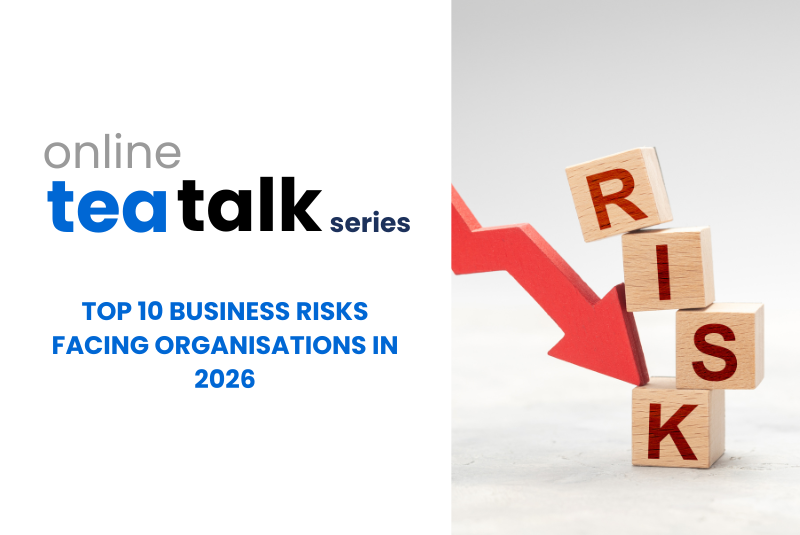
As ten critical global threats converge in 2026, organisations must abandon static planning and build continuous operational resilience to survive.
Key Insights
- Business risks no longer emerge in isolation; threats like cyberattacks, climate extremes, and geopolitical instability now amplify each other into exponential polycrises.
- Traditional, static risk frameworks fail when faced with sudden supply chain shocks, regulatory fragmentation, and macroeconomic volatility.
- To secure their long-term viability, leaders must build agile, cross-functional capabilities that use proactive intelligence to anticipate and respond to disruptions in minutes.
At its core, a business risk is any internal or external uncertainty that can threaten an organisation’s ability to achieve its strategic and operational objectives.
In 2026, these risks no longer emerge in isolation. Leaders face converging threats, from geoeconomic tensions to misuse of artificial intelligence (AI), that are no longer purely theoretical. A single disruption, such as a sudden tariff shift or a targeted deepfake campaign, can quickly ripple through an entire distribution network.
To thrive, businesses must adapt; static planning cannot survive these fast-moving shocks. These compounding threats actively shape strategic and operational decisions, severely limiting tactical options for those who fail to prepare.
The Institute of Enterprise Risk Practitioners (IERP®) hosted a Tea Talk titled “The 2026 Risk Landscape: What Every Organisation Should Prepare For”, which outlined the business risks that should be on every corporate radar. Ramesh Pillai, Chairman of the Board of Governors for the IERP®, explored how to interpret this evolving landscape and translate foresight into action by identifying ten critical global threats for 2026.
Systemic Cyber Risk and the Need for Cyber Resilience
Expanding IT systems, third-party vendors, and distributed workforces have increased vulnerability across systems, core logistics networks, and operational technology. State-sponsored and criminal actors now routinely target vital sectors like energy, finance, and healthcare.
Since a single high-impact incident can halt digital services for months and cripple logistics networks, businesses should modernise security controls and embed cyber resilience into their strategic planning. Success requires a culture of preparedness that ensures uninterrupted continuity and rapid recovery during an attack.
The Dual Edge of AI
While AI shapes both risk and resilience, malicious actors have successfully weaponised it for cyberattacks, phishing schemes, and ransomware-as-a-service. The sheer volume and complexity of these machine-driven threats now outpace conventional controls.
Ramesh suggested a future-ready approach to navigate the dual edge of AI. Firms should proactively harness it for business continuity while investing in strict oversight, risk management, and response mechanisms. Safeguarding against these evolving, automated threats requires embedding strong cyber resilience directly into core workflows.
Escalating Climate Risk
From wildfires to floods, the growing frequency and intensity of extreme weather elevate climate risk from an environmental concern to a core strategic threat. Companies worldwide face profound interruptions throughout their supply networks and regional economies.
As climate-driven disasters increase in magnitude, events once rare are placing unprecedented strain on infrastructure. Ramesh highlighted data from the United Nations Disaster Risk Reduction Global Assessment Report, noting that insurance payouts related to natural disasters averaged 1.9% of the world’s annual gross domestic product (GDP).
Geopolitical Risk
Geopolitical instability, the aggressive use of economic policies, and increased use of sanctions are among the most pressing business risks an organisation must manage. These intertwined threats accelerate volatility and fracture operational resilience.
The cascading effects of geopolitical conflicts paralyse global trade flows, create chokepoints at vital shipping lanes, and trigger sudden commodity fluctuations. When regional conflicts erupt or trade policies shift, essential supplies face heavy delays, while currency fluctuations and shifting insurance markets complicate financial planning.
Businesses relying on single-region sourcing or just-in-time inventory models are exceptionally vulnerable when geopolitical risk materialises. Without diverse supply networks, access to essential materials can vanish overnight, causing stranded inventory, costly production outages, and widespread systemic breakdown.
Business Interruption and Supply Chain Risk
In today’s interconnected landscape, disruptions can rapidly halt production and delay sales. Ramesh stressed that it is imperative for businesses to maintain complete visibility of their networks, from raw material origins to final distribution.
The ripple effects of supply chain delays extend beyond physical goods. Digital supply chain risk is equally pressing; dependence on third-party IT providers means a single outage can trigger a systemic domino effect, derailing operations across multiple enterprises simultaneously.
Industries that rely heavily on just-in-time inventory and lean operational models remain especially vulnerable to compounding operational shocks.
Misinformation and Disinformation
The rapid spread of deepfakes and false narratives has become a business risk that threatens both private and public sector entities. Maliciously crafted content actively disrupts crisis communications, impedes effective risk management, and triggers real operational failures.
Ultimately, this distorted information landscape fractures internal alignment. It chips away at leadership credibility and creates widespread stakeholder confusion where clarity matters most.
Regulatory Fragmentation, Tariffs and Trade Restrictions
Companies face a fragmented landscape of regulations, tariffs, and trade restrictions. It creates commercial uncertainty, elevating compliance risk to a board-level priority.
Sudden updates to sanctions or export controls can stall cross-border trade, trigger shipment delays, and constrict data flows. Left unmanaged, this regulatory complexity creates severe commercial bottlenecks.
The best position for firms is to synthesise compliance, trade, procurement, and risk management into a unified strategic view so they can respond to regulatory shifts. Building these agile capabilities enables informed decision-making, ensuring continuous operational resilience despite shifting global mandates.
Macroeconomic and Financial Instability
Macroeconomic and financial instability challenge entities striving for business continuity and operational resilience. Today’s volatile environment, driven by persistent inflation, fluctuating interest rates, and trade policy shifts, directly disrupts working capital, revenue streams, procurement cycles, and more.
Even financially sound firms face sudden cash flow pressures, increased costs, and simultaneous shocks to supply and demand from unstable macroeconomic environments. Ramesh suggested building more resilient organisations by integrating technology and aligning enterprise risk management strategies with business goals.
Talent Shortages and Skills Deficits
Many firms face a capability gap rather than a mere headcount shortage. Unfilled crucial roles slow incident recovery, erode institutional knowledge, and stall modernisation.
As skills mismatches and workforce ageing accelerate, Ramesh noted that closing this gap is a core business strategy, not just a human resource responsibility. Firms must urgently prioritise reskilling, hiring, and managed services to address immediate gaps.
Polycrisis: Overlapping Business Risks, Exponential Impact
A polycrisis emerges when multiple risks materialise simultaneously, amplifying one another to create exponential fallout that surpasses any single incident. Ramesh shared that an armed conflict might sever supply chains and drive inflation, just as extreme weather devastates key manufacturing hubs and cyber threats target distributed workforces.
When these compounding threats converge, they rapidly overwhelm crisis management protocols and paralyse entire sectors. The resulting extended downtime, mounting financial losses, and eroded stakeholder trust can directly threaten a business’s long-term viability.
Addressing Enterprise Risk Management Gaps To Build Operational Resilience
Many businesses still operate with gaps in their enterprise risk frameworks, often relying on untested contingency plans and lagging in predictive technology investments. Some lack clear communication protocols or have insufficient formal budget allocation.
To build robust operational resilience, leaders must adopt an agile, proactive approach that enables faster decision-making. Ramesh recommended five core actions:
- Plan for potential disruption: Use dynamic risk intelligence and scenario analysis, quantifying impacts to allocate resources before threats escalate
- Monitor vulnerabilities across people, supply chains, and technology: Deploy AI-powered tools to ensure continuous situational awareness
- Alert stakeholders with speed and clarity: Leverage targeted, multi-modal notifications, accelerating threat detection to cut response times from hours to minutes
- Respond decisively: Establish a coordinated command, replacing fragmented systems with a unified view to seamlessly mobilise cross-functional teams
- Improve continuously: Institutionalise post-incident learning, updating playbooks, and refining enterprise risk management with business continuity plans
Ultimately, the defining business risk firms should prepare for in 2026 is the convergence of complex threats, from AI-driven cyberattacks to escalating climate volatility. With disruptions becoming a constant, resilience cannot remain a static goal.
Ramesh concluded, “Organisations that operationalise future-ready strategies and deploy advanced solutions will not only survive all this uncertainty but thrive, transforming adversity into sustained strength, and more importantly, opportunity.”