

















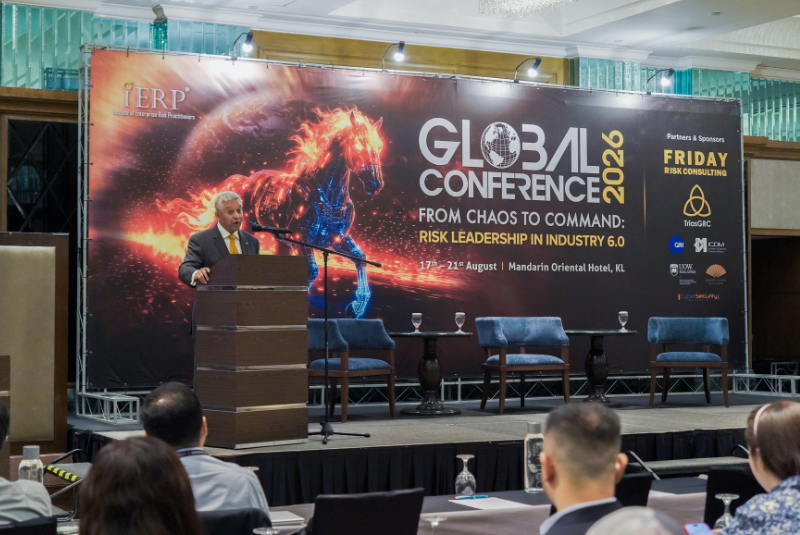
In an era of hyper-intelligent, fully autonomous, and virtualised industrial ecosystems, risk leaders today must become active architects of enterprise resilience.
Key Insights
- The Institute of Enterprise Risk Practitioners (IERP®) Global Conference 2026 challenged risk leaders to abandon defensive strategies and proactively architect enterprise resilience for the autonomous realities of Industry 6.0.
- Speakers urged organisations to dismantle operational silos to expose hidden vulnerabilities across nth-party supply chains, internal risk cultures, and AI-driven fraud.
- Securing a competitive advantage requires executives to integrate radical digital literacy with robust ESG frameworks to navigate ongoing macroeconomic volatility.
The IERP® Global Conference 2026 brought together forward-thinking leaders to redefine enterprise risk management for the Industry 6.0 era.
With cognitive AI, quantum computing, and the industrial metaverse accelerating the way risk moves, legacy playbooks are rapidly becoming obsolete. Setting the tone in his opening address, Chairman of the Board of Governors of the IERP® Ramesh Pillai noted that threats no longer send early warning signals, but instead strike across borders instantly.
“We are no longer just managing businesses; we are navigating an unprecedented paradigm shift called Industry 6.0,” he said, challenging executives to move from defensive postures to commanding strategic adaptability.
Throughout the event, delegates engaged in critical dialogues exploring how governance, risk, and compliance (GRC), cyber risk, and environmental, social, and governance (ESG) strategies must converge to build secure, future-ready businesses.
Backed by strategic partners including Friday Risk Consulting, TriasGRC, the Global Reporting Initiative, the Institute of Corporate Directors Malaysia (ICDM), the University of Wollongong (UOW), Cybersecurity Malaysia, and Mandarin Oriental KL, the conference set out to address these shifting dynamics, starting at the very top.
The New Boardroom Reality: Geopolitics, Trust, and Enterprise Risk Management
Today’s executive leaders operate in geopolitical reality where corporate legitimacy and adaptability matter more than traditional controls. These power plays have shifted from distant background noise to immediate boardroom priorities, demanding a more dynamic approach to enterprise risk management.
Addressing this macroeconomic volatility, Bintang Capital Partners Berhad Founder and CEO Datuk Wira Johan Rozali-Wathooth and Bank Muamalat Malaysia Berhad Chief Economist Dr Mohd Afzanizam Abdul Rashid explored the forces shaping the new competitive order.
They highlighted the pressure points where executive decisions matter most, equipping leaders to build resilience, seize strategic opportunities, and lead through a fractured global landscape with confidence.
Alongside these macroeconomic shifts, the CEO’s role in steering organisations through transformation has never been more essential. Insights from the CEO Panel, featuring Aurelius Healthcare GMD and Chairman Dato’ Amir Firdaus Abdullah, Coca-Cola Southeast Asia CEO Tolga Cebe, and Mercedes-Benz Financial Services CEO Anamika Talwar, focused on leading with credibility.
This session explored how executives can drive adaptability, strengthen culture, and build trust as a strategic asset. By aligning leadership with core values, robust ESG principles, and social responsibility, they demonstrated how to maintain stakeholder confidence and turn reputation into a lever for long-term business success.
While these panels anchored the broader plenary agenda, the conference soon shifted into three concurrent tracks: Stream A, Stream B, and Stream C. This format allowed delegates to move from macro-strategy into specialised domains, tackling the specific operational, technological, and sustainable risks defining their industries.
Uncovering the Hidden Web: Supply Chains, Culture, and Digital Fraud
Traditional risk registers stop one level too early, leaving organisations blind to deep supply chain vulnerabilities, cultural drift, and sophisticated digital deception.
To map this evolution from third-party to nth-party risk management, Salman Nazir, Former Executive Director of Supply Chain at Nestle Malaysia, revealed how risk now cascades across interconnected networks. He stressed that managing this web requires proactive intelligence to trace vulnerabilities deep within the supply chain.
However, external supply chain vulnerabilities only tell half the story; internal threats pose an equally severe danger to modern GRC frameworks. Andy Romanis, Chief Risk Officer at Olam Food Ingredients, unpacked how leaders should supervise risk culture as a system, shifting from perception-based narratives to measurable indicators and early-warning signals.
Outside these operational blind spots, this hidden web of risk extends into the digital space. A panel of compliance leaders, including AmBank Group’s Group Chief Compliance Officer Faradina Mohammad Ghouse, Maybank’s Group Chief Compliance Officer Yiow Inn Sann, and Senior Compliance and Regulatory Officer Julia Chin, explored how to defend corporate trust against AI-driven fraud that easily bypasses static controls.
Ultimately, to protect the organisation’s standing, risk teams must dismantle operational silos. By integrating nth-party visibility, cultural supervision, and digital intelligence directly into their GRC strategies, organisations can expose unseen risks before they turn into crises.
The Autonomous Frontier: Mastering AI and Cyber Risk
Organisations spent a decade building technological sovereignty, but AI reversed it in two years, forcing businesses to manage dependencies on a handful of foundational models.
Mapping these concentration points, Reece Soukoroff, Global Threat Intelligence Strategist at NOF Consulting, exposed the supply chain behind the supply chain. He shared real examples of failures that rippled through dependencies organisations didn’t know they had.
Vishal Singhvi, Global Head of Agentic AI and GenAI at The Heineken Company, highlighted how this vulnerability multiplies as AI shifts from automation to action.
He cut through the hype to distinguish between agentic and rogue AI, exposing where autonomy creates value and where it generates serious enterprise risk. Leaders must harness these agents without losing control, as visibility is no longer optional in detecting dangerous behaviour early.
Furthermore, Associate Professor and Principal Investigator at the Centre for Quantum Technologies at the National University of Singapore, Dr Manas Mukherjee, warned that ignorance about quantum technologies will likely become fatal, potentially proving even more damaging to businesses than AI itself.
The Strategic Imperative: Upgrading ESG to a Competitive Edge
Sustainability has matured past basic compliance, evolving into a hard metric for business valuation and operational resilience. Yet, many organisations still treat ESG reporting as a massive data-collection exercise rather than a driver of corporate value.
Yazmin Islahudin, EDOTCO Group Head of Sustainability and Governance, cut through the compliance trap and revealed how leaders can cut through the noise of endless metrics.
She provided a practical blueprint for isolating the high-impact data points that influence board-level strategy, transforming heavy reporting burdens into a distinct competitive advantage.
Moreover, the rapid acceleration of AI introduces a new tension between technological growth and resource conservation. Ivan Li, Founder and Managing Director of Climant Impact, shifted the conversation from basic carbon emissions to the broader sustainability impact of scaling AI infrastructure.
While AI unlocks significant economic value, Li highlighted its immense demands on energy, water, and land. He stressed that executives must carefully weigh these trade-offs, as infrastructure and governance decisions will dictate whether AI creates or erodes long-term value.
The New Enterprise Risk Management Mandate
As delegates reconvened from their respective streams for the closing panel discussions, a unified theme emerged: the future of risk management demands speed, visibility, and integrated resilience.
As organisations face unprecedented disruptions, from autonomous AI systems to evolving ESG requirements, defensive strategies no longer suffice. Moving from chaos to command requires a shift from a defensive posture to a proactive leadership style, which relies on three core strategic pillars.
- Achieving radical digital literacy: Risk teams must integrate continuous risk modelling and AI-driven early-warning indicators
- Tearing down corporate silos: Risk teams should unite cross-functional teams to evaluate vulnerabilities holistically
- Embed a risk intelligent culture: A risk intelligent culture across the entire workforce, ensuring every employee can spot and mitigate risks in real time
As Ramesh stressed in his keynote address: “The future will not wait for legacy frameworks to catch up.” For the global IERP® community, the mandate is clear: build an agile foundation, embrace the chaos, and lead with confidence.